
The Kind of House Buyers Are Willing To Pay More For

That spare room on the main floor. The finished basement with a kitchenette and its own entrance. The bonus room you've been using for storage.
To you, it's extra space. But to a growing pool of buyers, it's the reason they'd pick your house. Here’s why. Multi-generational homebuying is on the rise.
Millions of Families Are Living Multi-Generationally
The number of multi-generational households is climbing. That’s when 3 or more generations live under one roof. And data shows those households grew from 3.2 million to almost 4 million between 2014 and 2024, according to Realtor.com.
And each year, more people are shopping for a larger home that fits their combined needs.
While the appetite for this type of house is rising across the board, data from USAFacts shows multi-generational living is more common in some states than others. The darker the state in the map below, the more common it is in that area (see map below):
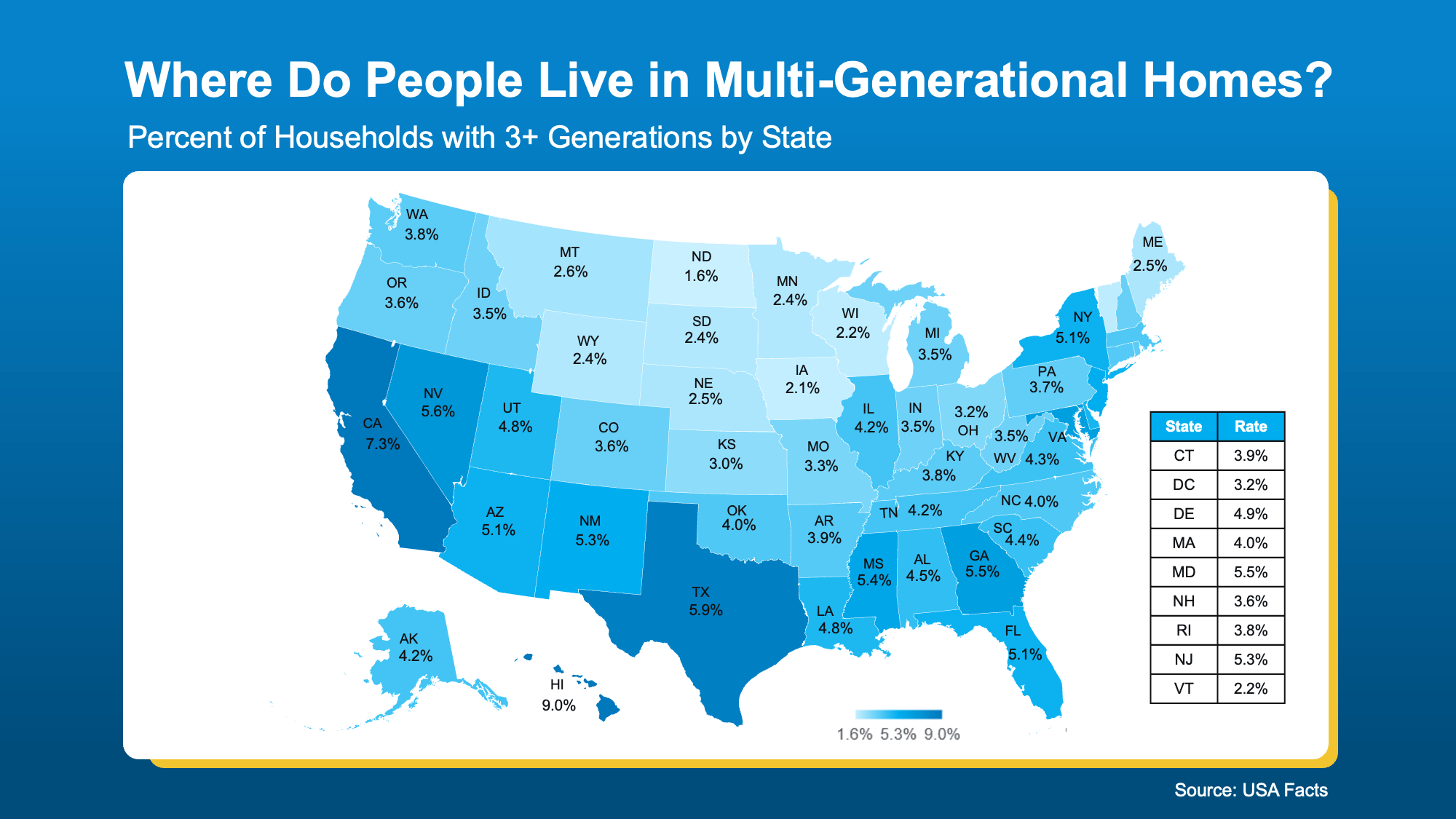
Where does your state fall? Depending on where you are, the pool of buyers looking for a house like yours could be even bigger than you’d think. But the overall bottom line is this.
There’s a real market out there for larger homes with room for multiple generations under one roof, especially since affordability is still so tight. And if you own a house like that, it’s in demand.
Multi-Generational Houses Sell at a Premium
And that extra room carries real value with the right buyer. According to Realtor.com, in 2025 the median asking price for a multi-generational house was $709,000 – roughly 65% higher than the $429,900 median for a standard house.
Some of that is simply size. But compare multi-generational homes to regular homes with the same amount of square footage, and they still come out on top – $262 per square foot versus $215.
That’s a 22% premium you could command for special features like in-law suites, second kitchens, and separate entries (see graph below):
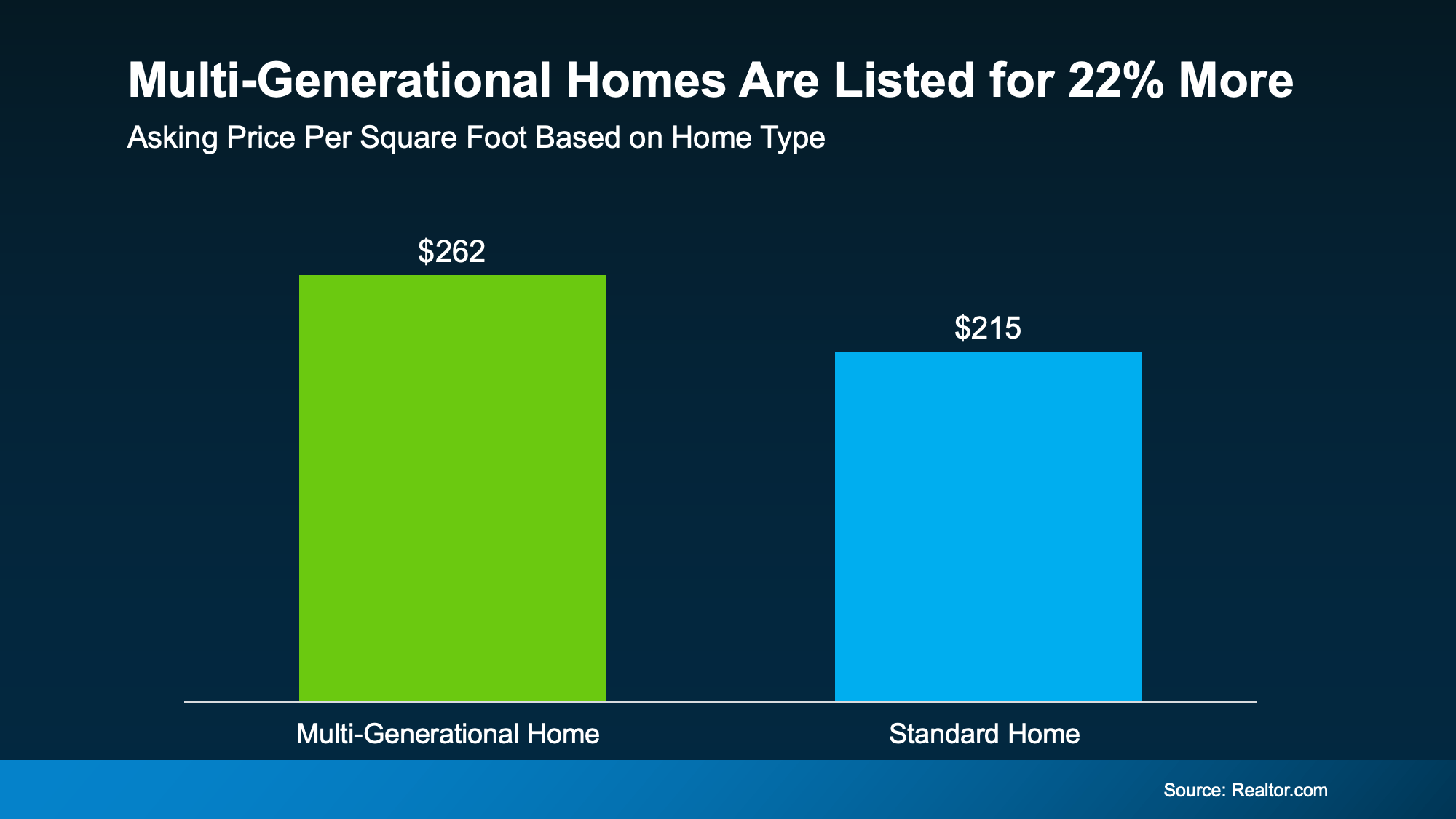
When you sell, this could help you walk away with more money in your pocket, especially when your agent highlights your home’s multi-generational-friendly features in your listing.
And Buyers Aren’t Getting Sticker Shock
And even with slightly higher price tags, buyers aren't flinching. Multi-generational houses drew 13.5% more online views than standard ones, and they still sold just as fast – in about 59 days – per the same Realtor.com report.
Hannah Jones, Senior Economic Research Analyst at Realtor.com, explains:
"The strong demand and steep premiums we are seeing in inventory-constrained markets point to a real mismatch between what buyers are looking for and what is actually available. For sellers in these markets, this type of home can be a significant asset."
Basically, when buyers want something that's very specific, the house that checks the box tends to stand out.
Frequently Asked Questions
Q: What specific home features command a 22% premium for multi-generational living in Beverly Hills? A: To achieve a 22% price-per-square-foot premium, our analysis highlights the importance of highly functional and independent flexible spaces. In Beverly Hills and Westside luxury properties, the most coveted features are:
-
Fully Appointed Guest Suites/Guesthouses: Self-contained units, detached or integrated, with a complete kitchenette/full kitchen, bedroom(s), and primary bath.
-
Dual Primary Suites: Two full, separate primary bedroom and bath combinations on different floors.
-
Separate Entrances: Private ingress/egress, crucial for providing multi-generational autonomy and privacy.
-
Secondary Kitchens/Flex Kitchens: Full or compact secondary kitchens are a prime differentiator for a house to be truly multi-generational friendly.
-
"In-Law" Suites: Lower levels or private wings configured as flexible living spaces, often featuring accessibility considerations.
Q: Why is the trend for multi-generational homes on the rise, and how does it affect Beverly Hills luxury real estate? A: This trend is driven by two main factors: increasing desire for cohesive family living across generations (often for supportive and lifestyle reasons) and the continued constraint of high-end inventory. High-net-worth families are actively searching for estates with enough flexible living spaces to house adult children, elderly parents, or private staff, balancing proximity with true independence. The shortage of this type of "very specific" inventory creates high demand and significant premiums in exclusive markets like Beverly Hills and the Westside, where such estates are considered a "significant asset."
Q: Do larger multi-generational homes in Beverly Hills take longer to sell? A: No, our data shows they do not. While they are a more "specific" property type, multi-generational properties are very much "in demand" and draw intense attention from qualified luxury home buyers. They received 13.5% more online views and sold just as fast—roughly 59 days—as standard single-family homes in competitive markets. This indicates that a well-appointed property with high-value multi-generational features checks a critical box for buyers, causing it to "stand out" and secure offers quickly.
Bottom Line
Your multi-generational-friendly, or simply larger-than-average, house might meet criteria a lot of buyers can't find in a standard one. That's what gets attention. And offers. So, let’s chat about what it could get you in our market right now.
Whether you’re selling next year or just giving your house some TLC... Let’s have a quick conversation about whether it’s the right decision for your home.
Contact Christophe Choo
Phone: (310) 777-6342 | Email: [email protected]
To tour your future home and search communities click "HERE".